Mind-to-Machine 2.0 · GDGoC CUI Wah · November 2026
Plan a hackathon from the organiser's messages.
Paste the emails, WhatsApp texts and notices, in English or Roman Urdu. The planner produces the schedule, venue, food order, judging rota and budget, checks them, and shows which message each figure came from.
The example is a saved run on the judges' test pack. You can add messages to it.
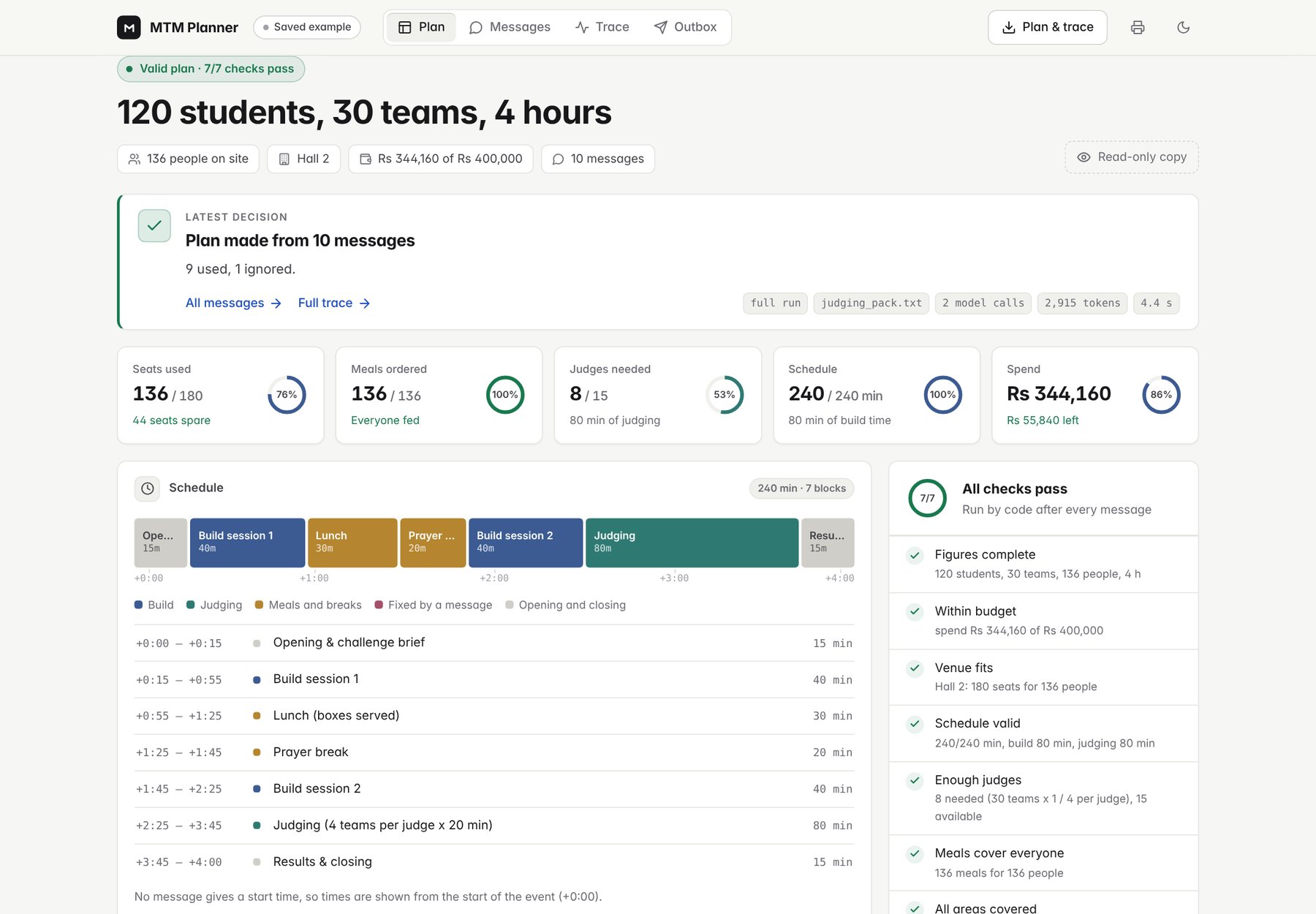
The plan view for the saved example.
How it works
The model only reads. Code does the planning.
One model call turns the messages into facts. Ordinary code then applies the rules, does the arithmetic and runs the checks, so the figures are exact and repeatable.
Read the messages
Each message keeps its sender, channel and date.
Keep the facts that count
A fact is used only if its sender is allowed to set it. The newest message wins.
Build and check the plan
The same seven checks run after every new message.
Details
Built for messages that keep changing.
Wrong messages are rejected with a reason
A sender without authority, an out-of-date price, or a change that would leave people without food is rejected. The last accepted plan stays in place.
The newest message wins
When a price or an option changes, the older fact is replaced and every total that used it is recalculated.
[superseded] #9 Hall 3 under maintenance
[ignored] #10 Library closing early
Every model call is recorded
Each call is numbered with its model, area, input, output and token count. The plan and the full trace download as one text file.
Small, predictable updates
npm run plan -- messages.txt for the first run and for every update. A new message uses at most 5 model calls, usually 1.
No figures written into the code
Every number comes from the message file, so a pack it has never seen works without changes.
Replies are drafted, not sent
Each sender gets a draft reply on the channel they used, written from the plan. A person always presses send.
Try it with the saved example.
Send it a message that should be rejected and see what it does.